Thursday, 22 May 2025
Now Open: cofunia – A Sensory Retreat along the Yamanobe Ancient Trail, Nara

In 2021, It All Began with a simple post on SNS, “We’ve inherited a kofun. Anyone want to use it?”
—and to our surprise, it struck a chord. Many people asked, “You can inherit a kofun?”
In Japan, there are over 160,000 kofun (ancient burial mounds), many of which quietly exist in everyday life—as farmland, parks, or private land.
At the foot of the 114-meter-long Nishiyamazuka Kofun stood a cluster of seven traditional houses, over 100 years old. Long abandoned, they had fallen into ruin.
From Abandoned to Alive Again as accomodation
The houses were nearly beyond repair—leaking roofs, collapsed beams, ghostly silence. It would have been easier to tear them down.
But we felt something here: a presence of time we didn’t want to erase.
While most architects said it was faster to demolish, "Team Clapton"— a group of architects, believed in restoration. Together with volunteers from across Japan and abroad, we began the renovation.
In 2025, cofunia Opened
Three years later, cofunia officially opened in March 2025.
It’s the first accommodation in Japan where guests can stay at the foot of a kofun.


The concept: Five Senses × Five Elements
Each of the four guest rooms is inspired by an element of ancient East Asian philosophy—Wood, Fire, Earth, Metal, Water—and offers a unique sensory experience.
Meals are served in the communal Fire Building, celebrating local ingredients, fermentation, and herbal traditions.

.jpg)


A Place to Rest—and Reconnect
A portion of each stay helps support the preservation of Nishiyamazuka Kofun.
The mound, once an orchard, is gradually being restored and opened to the community—today, you can even enjoy tea atop it.
Kofun are final resting places—but they also quietly offer wisdom for how we live today.
At cofunia, we hope to continue nurturing a way of life where people and kofun can coexist.
A Garden in Spring
This spring, we harvested tea leaves from the garden during Hachijūhachi-ya, the 88th night of the traditional calendar. With the scent of herbs in the air, we pan-fried the fresh leaves and sipped our own handmade tea.
The garden is waking up—plum blossoms swelling, grasses sprouting—and with it, the rhythm of cofunia as a place of rest has begun.
It’s a quiet, gentle space where the body and spirit can soften.
We look forward to welcoming you.
Chisato Maeda @ cofunia

-----
cofunia
Email: reservation@cofunia.co.jp
Tel: 0743-20-6393
Address: KAYOCHO, TENRI-SHI, NARA, 632-0042, JAPAN
HP:https://en.cofunia.co.jp/
IG:https://www.instagram.com/cofunia.nara/
Saturday, 25 November 2023
Free offer for a new online course on udemy "Course 1: The Essence of Japanese Fermentation"

Welcome to "Course 1: The Essence of Japanese Fermentation"
Discover the Art of Japanese Fermentation
Join Chisato Maeda, a fermenter and ethno-botanist, on a culinary journey through Japan's rich fermentation heritage. Our course, "The Essence of Japanese Fermentation: Comprehensive Guide from Ancient Traditions to Home Cooking," offers a deep dive into the world of Koji, miso, soy sauce, and much more.
Unlock the Secrets of Traditional Japanese Fermentation in Your Own Kitchen!
Free coupon in 31 days
Here are free coupon offering for you, upon launching the new course.
Limited Time Offer: Get 100 Exclusive Udemy Redemptions with Code 7CDF46D90E2A986392AF (Expires in 31 Days)
https://www.udemy.com/course/the-essence-of-japanese-fermentation/?couponCode=7CDF46D90E2A986392AF
.jpg) |
Why This Course?
- Cultural Insight: Explore the historical and traditional aspects of Japanese food culture.
- Scientific Exploration: Gain a thorough understanding of the chemistry and biology behind fermentation processes.
- Hands-On Learning: Engage in practical home experiments to bring your knowledge to life.
- Foundation for Specialization: Ideal for culinary enthusiasts, professionals, and anyone passionate about wellness and Japanese cuisine.
Course Structure
- Module 0: Preparation for Your Fermentation Journey
- Module 1: The Culinary Canvas of Japan: Food Culture and Fermentation
- Module 2: Basics of Fermentation Science
- Module 3: Introduction to Japanese Fermented Products
- Module 4: Crafting “Ichiju Sansai (one soup, three dishes)” with Practical Recipes
What you will gain from this course
Benefit 1: Comprehensive Textbook
You will receive a 100-page PDF textbook filled with in-depth knowledge, tips and secrets about Japanese fermentation at the end of the course.
Benefit 2: Seasonal one-soup-three-course recipes
You will receive 10 seasonal one-soup-three-course recipes (5 for spring/summer and 5 for fall/winter).
Assignment 1: Miso Tasting Challenge
Develop your sense of taste through miso tasting. Understand the characteristics of various types of miso and practice incorporating them into your daily diet.
Assignment 2: Making pickling beds
Students will practice making pickling beds and pickle familiar foods. Pickle beds such as miso pickles, yogurt miso, traditional 358 pickles, and amasu-zuke pickles.
Assignment3: Crafting Ichiju Sansai
Apply your knowledge from the course to design a seasonal "Ichiju Sansai" menu that captures the essence of the selected season through a harmonious blend of flavors, textures, and nutrition.
Q&A
Q: What are some of the key ingredients used in the cooking lessons for this course?
A: Key ingredients include various types of fermented seasonings miso, soy sauce, vinegar, sake and mirin. Also Japanese foods such as tofu, seaweed, radish, konjac, etc.
Q: What should I do, if these ingredients are not available in my county?
A: Alternative ingredients are suggested instead of using specific ingredients which are unique to Japan.
Q: What is "Ichiju Sansai," and how is it relevant to the course content?
A: "Ichiju Sansai" refers to the traditional Japanese meal structure of one soup and three side dishes. The course teaches how to create meals using this structure, highlighting the use of fermented seasonings.
---------------
Please find the detail in the link below:
udemy course "Course 1: The Essence of Japanese Fermentation"
Wednesday, 21 March 2018
[2-6th May] "5-Day Brewing Week" Fermentation School in Nara
"GOLDEN FERMENTATION WEEK!"
■What is Fermentation School?
With the basic course of "5-day fermentation school" by the Food Expert Ms. Izumi Iguchi, there will be two optional courses; "koji malt studies" and ""ethnobotany.You can choose the schedule by yourself based on your interests and convenience.
The venue of Uda city in Nara has been known as historical town of plant medicine, which is recorded in the " Nihon-shoki" (the oldest chronicles of Japan).
How about learning the art of fermentation and biodiversity of fungi and plants in Nara?

ーーーーーーーーーーーーーーーーー
■Basic Class "5 day fermentation"
Lecturer : Food Expert Ms. Izumi IguchiYou can learn "Do-It-Yourself wildcrafting" by using local daily ingredients, and enjoy living together with invisible microorganisms.
You can get more than 100 of recipes, written by Izumi, after a lot of trials and efforts. Once you learn from this lesson, you can use it in your lifetime!
Duration of the Basic Class would be 5 days, however, you can come whenever you like based on your schedule. (The lesson fee will be same how many times you come)
What you can learn from this lesson:
* How to use fermented products
* Make fermented foods
* Make your own body to be fermented
What you make
✴Germinated Rice bran malts
✴Fermented rice water and recipe
✴Enzyme of Seasonal herbs and fruits
✴Yogurt (soy milk yogurt by using plants), and mayonnaise by using soy yogurt
✴Naturally fermented water kimchi without using vinegar
✴Cabbage Choucroute
✴How to use sake lee, and how to make aging lees
✴Fermented seasonings (natto shoyu, vinegar onion)
✴15 minute miso
✴Wild cidar by using fruits


■Optional Class "koji malts"
Lecturer:Malicafe Marika Groen
You can learn whole process of making koji malts at your home; how to control temperature, formation of enzyme, with both lecture and practical lesson. It will need 3 days.
You can learn:
* Diversity of Koji malts in Asian countries
* What is koji, where is it from?
*Asperguillus Flavus
* How to make koji starter by using wild fungi (such as rice malt starter)
* History of koji and brewing in Japan
* Bodaimoto, the older method of brewing in Japan
* How to make bean koji and wheat koji
* How to make soy sauce, etc
Schedule
3rd May Steaming, inoculating, Lecuture
4th May Managing koji malts, Lecture
5th May Finishing process

■Optional Course "Ethnobotany1: foraging and medicinal sake making"
Lecturer: Satoyama Library and Mr. Plant Hunter
Fieldwork of plant medicine with a local plant hunter. You can learn how to distinguish medicinal plants and make your own medicinal sake.


■Optional Course "Ethnobotany2: Natto by using wild plants"
Lecturer: Satoyama Library
Natto can be made from varieties of wild plants with conbination of varieties of beans and peas. You can taste how it will be deferent depending on the types of beans and peas,


ーーーーーーーーーーーーーーーーー
■Program
2nd May13:00-17:00 Basic Course 「5 day fermentation 1 」
3rd May
10:00-13:00 Basic Course 「5 day fermentation 2」
14:00-17:00 Optional Course「Koji malt 1」
18:00-20:00 Fermentation Night (option)
4th May
10:00-13:00 Basic Course 「5 day fermentation 3 」
14:00-16:00 Medicinal plant2 How to make natto by natural plants
17:00-19:00 Optional Course「Koji malt 2」
5th May
10:00-13:00 Basic Course 「5 day fermentation 14」
14:00-16:00 Optional Course: Medicinal plant2 How to make natto by natural plants
17:00-19:00 Optional Course「Koji malt 1」
6th May
10:00-14:00 Basic Course 「5 day fermentation 5」
■Venue
Inasa yuto1312 Nunobiki, Haibara, Uda city Nara
■Participation fee
【Basic Class】5 day fermentation workshop 32,000 JPY including recipes【Optional Class】Koji malts 12,000JPY (for 3 days)
Ethnobotany 2 Days 8,000JPY 1 Day 4,000JPY
【All Classes】 50,000 JPY
【Fermentation Night】One Fermented Food
*Schedule could be changed
*Not Included : Lunch of 2rd May (Included on the 3rd to 6th),Dinner, Accommodation
■Min.&Max. Participants
8-15 persons■Inquiry
Please Inquire (info[at]satoyamaplan.com)
■Profile of lecturers
Basic Class "5 Day Fermentation"| Izumi Iguchi
She learnt cooking at Fukuoka, Tokyo and France, and continues to explore food ingredients grown from the earth. In her cooking class, freshly picked herbs and vegetables from the garden are used, and theme of the lesson would be seasonal preserved food and enzyme. She also engages in developing products, working together with produces.
Optional Class "Koji malts studies" |Malicafe Organic Vegan Food, Marika Groen(茉莉花)
She lives in Amsterdam, teaching koji malts, miso, and fermentation in the Netherlands. When she is back to Japan, she travels all around Japan in seek for breweries, tradition, arts, and fermentation. Freelance photographer.
Optional Class "Ethnobotany"|Satoyama Libarary, Chisato Maeda
After completed Master degree of Agroecology from Wageningen University in the Netherlands, she travels around Asian villages to learn about traditional knowledge of farming and food preservation, seed saving from local elderly villagers. She moved to Uda city in seek for medicinal plants, and opened a share house, "Commons Garden".
■Photos taken at the time of last 3 day workshop


Tuesday, 6 February 2018
[3rd & 10th Feb 2018] Ultimate Slow Food: hunting Kudzu and processing kudzu mochi
"Indeed, this is ultimate!", said everyone during the workshop.

First, we went to mountain to find and harvest kudzu roots.
Kudzu is very pervasive weeds in summer, which can be seen everywhere, however, in winter season, the sign to find their roots is just vine and beans.
 |


We made effort to dig away such a big rock!


Finally, we did it!


filtering and precipitating impurities out of the water 5-6 times.


The following morning...

We made kudzu mochi.


This is not completely refined, and it will take another 5-10 days before refining completely, however, some said this crude kudzu tastes better, containing much more flavor, something like "full-body" kudzu.

The next kudzu processing tour will be held on the 10th February.
This article is about last event:
The art of Kudzu, cooking kudzu roots powder in Yoshino mountain
http://www.satoyamalibrary.org/2017/12/the-art-of-kudzu-cooking-arrow-roots.html
We can organize same kind of event if you can book with a group of more than 5 people. Please feel free to inquire if interested.
Monday, 5 February 2018
[27th-29th April 2018] 3-Day Fermentation Workshop in Kyoto
3 Day Fermentation Workshop in Kyoto
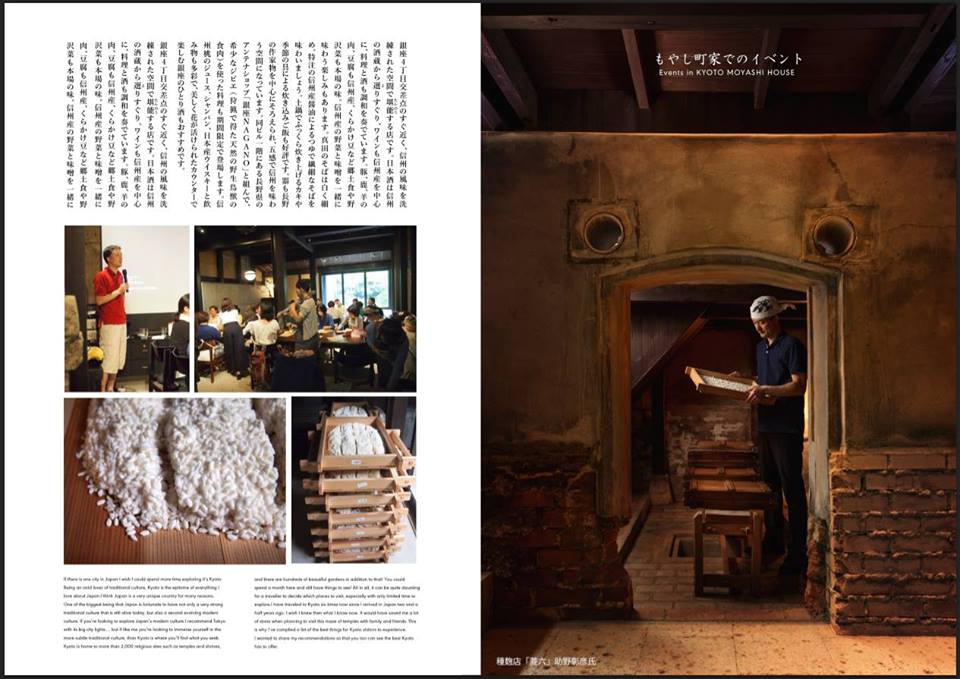
We are happy to announce our Koji (a kind of mold grown on produce such as boiled rice) making workshop on this coming April by Mr.Sukeno, the owner of 360 year old Hishiroku-Moyashi ,the only active Moyashi (koji starter) company in Kyoto.
毎回とても好評なこの講座は、製麹の技術のみでなく、発酵食の歴史や、微生物の分類などについても詳しく学びます。
実際の麹つくりは京都もやし町家に現存する、かつて「もやし」を醸していた麹室を使用して行います。


Date
Venue
場所 京都もやし町家 京都市下京区油小路六条下る西若松町268
Schedule
4月27日(金)10:00-17:00
作業①「水切」「蒸し」
講義①発酵食の歴史、微生物の分類、麹菌について
4月28日(土)10:00-17:00
作業②「切返し」「盛り」「仲仕事」「棒積み」「仕舞仕事」
「レンガ積み」等の製麹
作業の合間に
講義②「もやし」の話
講義③酵素の話、米麹パウダーを使った発酵豆乳について(試食)
4月29日(日)10:00-13:00
作業③「出麹」菱六種麹の解説・質疑応答
Participation fee
受講料38,000円(3日間の受講料・米麹のお土産付き)
Options:
以下は希望者のみオプションとなります。
4月28日ランチ (内容未定) 1,500円
4月27日懇親会 中之光庵 そばと発酵食 2ドリンク付き
6,000円
Cancellation Charge
一か月前から2週間前の前日まで20%
2週間前から一週間前の前日まで30%
一週間から2日前まで50%
前日・当日100%
Application
info@kyotomoyashihouse.com
moyashihouse.kyoto@gmail.com
+81 (0)75-708-3442 (week days 10:00-1700)
お申し込みは上記アドレスに
お名前
ご住所
電話番号
4月27日 ランチの要否・懇親会参加の有無
4月28日 ランチの要否
ランチご入用の場合アレルギーの有無
を記載の上、お申し込みください。
追って受講料等のお振込み先をご案内します。
ご不明な点などございましたらお気軽にお問合せ下さい。
皆様とともに学びの時間を持てますことを楽しみにしております!
Wednesday, 8 November 2017
Visit producers in Uda: Indigo Japan blue and Medicinal Plant Expedition
Wild medicinal plants master taught us how to distinguish porcelain berry (or wild grape, scientific name: Ampelopsis glandulosa) and ornamental grape vine (scientific name: Vitis coignetiae), how to make yakushu, alcoholic beverage for medicinal purposes by using natural resources such as Linden arrowwood (gamazumi in Japanese, scientific name: Viburnum dilatatum), silver vine, cat powder, matatabi in Japanese (Scientific name: Actinidia polygama), deodeok or lance asiabell (Tsuruninjin in Japanese, Scientific name: Codonopsis lanceolata), and so on.
Pick and eat, eat and learn, by using five senses, we learnt traditional knowledge of ancient people on living in co-existent with nature.

only use mountain water for 150 years in kasama indigo atelier
"When father-in-low went hospital, I thought someone has to learn how to take care of 150 years indigo vase. My husband is a business person, and only I could do that for the time being. This is how I started to learn, and got deep into this world."Said the 4th generation of Kasama indigo dyeing atelier, Ms Kayo.
In the village of Kasama, there are households earning their livelihoods by dyeing, blacksmith, farming... Nowadays, this knowledge is gradually disappearing. Dyeing workshop and black smith are also last one craftsman.
Ms. Kayo, still has hope to keep the lifestyle living with indigo as it is.


walk and eat: medicinal plant hunting in the forest.
After lunch, expedition for edible forests. |
Walking and picking wild plants.
|


 |
| flower of deodeok |

Wild kiwi, or baby kiwi (sarunashi in Japanese, scientific name: Actinidia arguta) is indeed little kiwi, when tasted. It is also good for making liquor.


We also plan to go for foraging and cook medicinal plants in spring.
