Showing posts with label livelihood. Show all posts
Saturday, 27 June 2020
Making kakishibu persimmon juice for natural dye
Yamanobe no michi and kaki persimmon cultivation
Yamanobe ancient trail runs along the eastern edge of the Nara Basin. Persimmon fields are dotted around the trail with full of ancient tombs with keyhole-shaped mounds.Actually, Nara Prefecture is the second largest production site of persimmons (kaki) in Japan, and along the Yamanobe trail, the Tonegaki and Hiratane species are well grown. However, did you know that more than 80% of the persimmons are thrown away?
Only one persimmon per branch can be harvested, and the remaining 3/4 of the fruit is thinned-out. This process takes one hour per tree. Persimmon farmers are aging, and they tend to give up producing kaki due to the lack of labor and the high shipping prices of persimmons despite of low income. They are not able to hold back.
We help thinning kaki, and received green persimmons in return, and make persimmon juice, kakishibu.


A green persimmon is pounded with a stone mortar and pestle and made kakishibu (fermented persimmon juice).
One is for freshly squeezed persimmon tannin and the other is for aged persimmon tannin.
One is for freshly squeezed persimmon tannin and the other is for aged persimmon tannin.

Raw squeezed persimmon tannin is cooked in a cauldron and the dyeing color is extracted.
In case of freshly pressed persimmon juice, the color turned creamy.
How does the color change when it will be fermented?

Ikkanbari, handicraft using kakishibu persimmon juice

Next day, squeezed persimmon juice started bubbling. It seems like doburoku, fermented rice alcohol.

We need to keep stiring for 10 days, then, filtered. The liquid will be fermented and aged for at least 1 year. Longer is better.
This juice is made in 3 years ago. It got dark brown.


We need to keep stiring for 10 days, then, filtered. The liquid will be fermented and aged for at least 1 year. Longer is better.
This juice is made in 3 years ago. It got dark brown.

Saturday, 10 August 2019
Self-sufficient life in hidden mountain village in Noto peninsula

2 hours from Kanazawa by car, in an isolated village called "Noto's Tibet", 5 families live together. There is a zen temple, which is known to those in the know.
It is natural to live with neighbors and visitors like one big family members, according to the villagers ,sharing one big bath with 5 families, having meals, raising village children, and building houses together.

Zen meditation starts 6:30 in every morning. Some went to beach to catch fishes, some enjoyed drawing, everyone could do different things, but shared meals and life stories.
I wanted to learn about indigo dye more, and kept dyeing whole day.
A village mother and an artist, Keiko taught me indigo dye and sewing. She is growing indigo plants by seeds, making sukumo (fermented indigo plants) by herself and design her original textile.
 | ||
handmade sukumo
|


 |
| Sewing khadi |

 |
| hanging scroll by Keiko san |
There are chickens in the farm. Fishes and shells can be caught in the ocean. Life is almost self-sufficient.

Many children are playing around together all the time in the fields, I had no idea whose children they are. Cats and dogs are also living together.
Grown up together with children from 5 families, they are still very friendly as if real brothers and sisters. Even after they got married and had children, they often come back to the village.
Nowadays, nuclearization of the family increases in Japan, and traditional community is disappearing. This style of co-existent life, something different from "ecovillage" or sharehouse, reminds us old and nostalgic way of living, which was standard before the WW2.
While meditation, so many ideas and future hopes came to my mind...


<neighbors>
Nakatani House, 400 years traditional house and Soba noodle cafe

Noto Ningyo washi : paper atelier

Saturday, 21 July 2018
Ama female divers village in Shima Peninshula
Hearing the voices of Ama female divers
Ama are female divers who go free-diving to catch shellfishes and seafoods like abalones, sea urchins, sea snails.without a breathing apparatus. The origin of ama dates back to 3000 years ago, which was recorded in the Chronicle of Japan.
They are still relying on the ancient methods of fishing until now without using modern technologies. This is to protect and appreciate the natural resources of their ocean.
It is said that ama divers are unique culture, which can be seen only in a part of Korea and in Japan. There are 2000 ama divers in Japan, and among them, half of divers are in the Shima peninsula of Mie prefecture.

Ama can dive into ocean for approximately 1 minute at one breath. They repeat this 20-30 times for one hour. Even 70 year old ladies, who feel difficulty in walking, still work for diving. The old lady said she found better in the sea rather than walking on the land.
Before the free-dive, they set fire in pray for their safety and to ward off evil spirit, even in the mid-summer. Mugwort of butterbur leaves are roasted and used as anti-fogging diving masks.
After 1-2 hours diving, they will get together to have snacks and chat. Although ama is lonely while diving alone in the sea, they always work in a group, so that all can keep eye on each other just in case of emergency. It is said that before, they sometimes witnessed sharks in the sea.


Recommended place to visit in Shima
Sea-Folk Museum in Toba
Founded in 1971, the Sea-Folk Museum preserves over six thousand exhibits about Toba’s ancient fishing traditions and antique fishing equipment.
Its architecture is also unique, and must-see destination, designed by a Japanese architect, Mr. Hiroshi Naito of Naito Architect & Associates. It was awarded several prizes, including Award of Architectural Institute of Japan by Architectural Institute of Japan.

Iwato-kan
It produces salt by using only seawater in the ancient method. Recycled wood from houses is used for firewood. Sea water is poured into a kiln and burned for 3 days until the salt is completely crystalized. You can see the process of making sea salt.

Ama diver's guesthouse "AMARGE"
Ms. Rikako Sato, who became an ama diver 3 years ago, opened a guesthouse in Ijika town of the Shima peninsula. She will take her guests to the ama hut in the following morning, if it is the day of diving.https://www.ghamarge.com

Thursday, 3 May 2018
making tea utensils in a tea farming village
Located in the high land of Yamato Plateau, Yamazoe village is the largest production area of Yamato green tea in Nara prefecture.
We visited a wood workshop to make our own tea utensils.

These furnitures are all hand-made.

"Would you like a cup of tea?"
At a home of Yamazoe tea village, drinking tea together is just like a greeting.
When we visit a person in the village, first thing to do is drinking tea.
Then, we go to the workshop to select our own woods to process.

There are too many options to choose one...


 tea farm in Yamazoe village

We visited a wood workshop to make our own tea utensils.
In the entrance of the workshop, there are diverse varieties of timbers.

These furnitures are all hand-made.

"Would you like a cup of tea?"
At a home of Yamazoe tea village, drinking tea together is just like a greeting.
When we visit a person in the village, first thing to do is drinking tea.
Then, we go to the workshop to select our own woods to process.

There are too many options to choose one...

First, we adjusted size by using blader.
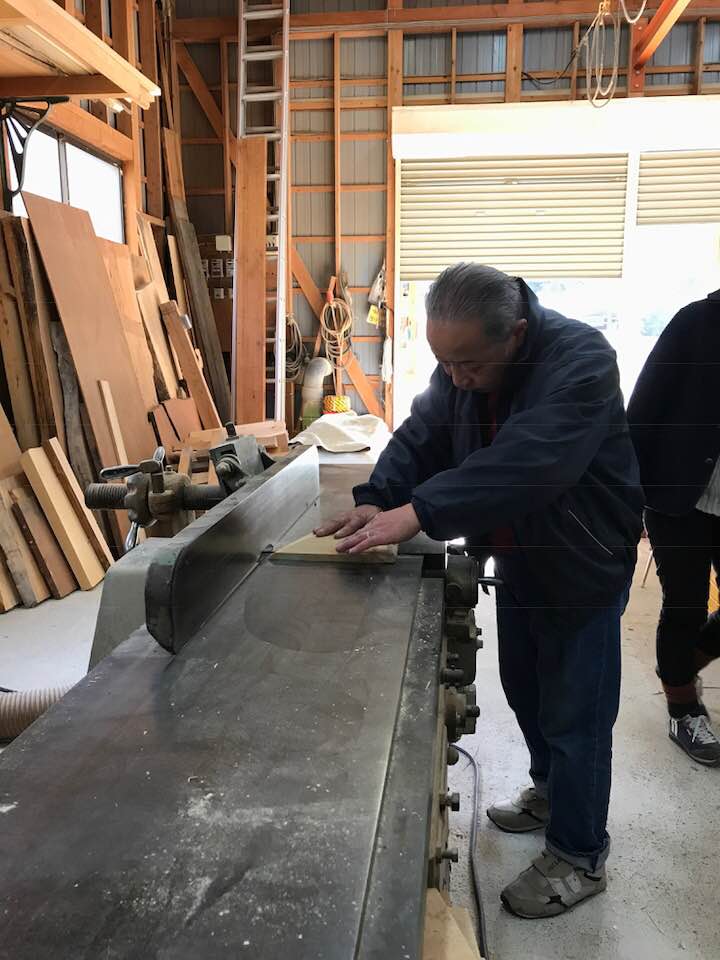
Then polish,


The last is to put wax on it.


Tea party by using tea board just made.


Sunday, 9 July 2017
Off-the-beaten Kyoto: landscape for propducing "ubai", carbonized plum fruit, used as a color fixing mordant

A hidden village of plum, Tsukigase, Nara prefecture
Taking train for an hour from Kyoto city, the hidden valley of Tsukigase village is known as a village of plum trees. However, it is hardly known that the plum tree was originally planted for processing "Ubai", carbonized plum fruit, used as a color fixing mordant."Most residents here were producing ubai, approximately 400 producers."
Said the last producer of ubai, Mr. Nakanishi.
Once, ubai had been a main industry in this area, since Edo samurai period. To make good plum, village people planted Joshuhaku, a variety of plum tree, which is bigger and easier to process.
After the Meiji revolution, ubai producers have been forced to close their business, due to the introduction of chemical dye.
Wisdom of making Japanese traditional "beni" color more brilliant
Benibana (safflower, Carthamus tinctorius) is one of the oldest dye in Japan, and it is found out that benibana was used in 6th century in Nara.Benibana has two pigment colors; yellow and red. To extract red color, called "beni" in Japanese, people used ash of akaza plant (Chenopodium album var. centrorubrum), and karamushi plant (Boehmeria nivea var. nipononivea).
 |
| safflower, benibana in Japanese |
After pounding benibana flowers like mochi, it is dried and solidified, which is called mochi bana.


Thread from karamushi plant is called "aoso". benibana dye will be more red colored after mixing benibana with karamushi


The ash of akaza plant is considered to be a good resource of strong alkaline content. It is added with banimochi.
○ubai
The last component is ubai. It contains high acid content, and mitigate strong alkaline water. After added with banibana dye, the beni color will be more vivid.
Making ubai

1. First, plum tree is covered with soot, called susu in Japanese. Nakanishi san get susu from neighbors, who are still burning wood for cooking.

2. fumigate plum fruits for 24 hours

2. fumigate plum fruits for 24 hours


3. dry under the sun for 1 month


ubai is now used as mordant for banibana dye, but that usage is very limited this time. In China or in Taiwan, ubai is also popular as healthy drink.
This landscape can be seen from 1st week of July to August.
Subscribe to:
Posts
(
Atom
)


