Showing posts with label agriculture. Show all posts
Friday, 1 November 2019
Mushroom farmer's lunch in Nara

Yoshino is famous for its Yoshino cedar tree but also it is blessed with good forest resources. Kinokono yakata is a restaurant located in Higashi Yoshino in Nara, 1.5 hours away from Nara city, providing locally harvested forest products, mushrooms and wild meats.
Hashimoto family is a small-scale mushroom farmer, cultivating various kinds of organic mushrooms for 30 years in Higashi Yoshino. In the restaurant, you can taste their homegrown shiitake, shimeji, lion’s mane mushroom, nameko, and maitake mushrooms. They also provide wild boar meats, if you wish to.

Full course meal of mushrooms includes roasted mushrooms (you can roast mushroom by yourself over a charcoal fire), nameko mushroom miso soup, daikon radish mochi, shiitake tsukudani, mushroom rice and dessert.


Their mushroom factory is located just next to the restaurant, and it is also possible to see around the factory freely after lunch.


All dishes use locally harvested fresh mushrooms grown adjacent room to the restaurant. It is very nice to see where and how it's grown.
Very friendly Hashimoto family will welcome you, if you wish to visit them.
"Kinoko no Yakata"
Higashi yoshino village, Nara Prefecture
Closed on Thursdays
Contact: 0746-42-0991(In Japanese)
Wednesday, 3 January 2018
Edible landscape: drying persimmon in a tea farming village, Ujidawara
Tea and persimmon mix cropping system in Ujidawara town, Kyoto
Every household growing tea plants also grows Tsurunoko, a variety of Kaki around the tea farm. November to December is off-season of tea farm, and suitable for making Hoshigaki(dried kaki).Ujidawara was said to be the birthplace of 煎茶sencha. Green tea production was started in the late Edo period. The sweet korogaki can be suitable confectionary to green tea.

A magazine published by Omotesenke, a head school of Japanese tea, which indicates kaki is the first confectionary served at tea ceremony, and chagashi, confectionaries in Kyoto have been created based on the sweetness and hardness of Korogaki.
There are many fruits available in Japan, but persimmons are different to pears or grapes in that they are much older. They can of course be eaten raw, but are even more nutritious eaten dried, as they contain larger amounts of potassion. The peel is also nutritious.
In Ujidawara, Korogaki is first served in 13th Dec. Its origin dates back to Zenjo-ji temple.
There is a story that a lady told villagers how to make hoshigaki (dried kaki). Peeled off, dried on kakiya, which is unique buildings to dry kaki in Ujidawara, and it’s ready to eat after 2-3 weeks.
There is a Kaki tree thicker than 2 persons surrounding the tree. It is said that at least 200 has passed. Nagatani Souen, who invented Sencha, 270 years ago. Korogaki maybe existed around that time.
"People could not have enough rice before. They survived by eating kaki. After harvested rice in fall, kaki can be harvested in Dec. Dried kaki can be last longer when there is no rice left."
Said a tea farmer in Ujidawara.
Importance of persimmon juice for tea
Farmers coat their tea farming tools in persimmon juice as a sterilizing agent, which has a strong odor.
Tea absorbs odors very easily, whether from makeup, cream or oil. But for some reason, persimmon juice does not seem to impact the fragrance of the tea at all.

So tea and persimmons make a good match right? It is interesting how both came to be cultivated together.
Persimmons and tea are well matched, but persimmons also aid the saké making process too. Persimmon juice was used to coat wooden sake barrels, and it is said that it stopped the brew from going bad or being discoloured in sunlight.

How to build kakiya (kaki drying house)
After harvesting rice, Kakiya (drying house) is built along the valley of Ujidawara.
6 people are working togher to build one kakiya. The roof is thatched by straw. The materials are recycled and used for 10 years.

The process is dependent on weather conditions, and so if temperatures drop as we expect, then there is no need to do anything. Lately, winters have been warmer and more humid, so that is making it difficult.
There is a specialist of just "peeling off". Experienced peelers can finish peeling 500 kaki per day.

There are 5000 kaki, and farmers should crumble kaki twice a day. It is indeed time consuming job.

Where are significant differences in temperature between the night and daytime, as well as the summer and winter seasons, there is good quality tea.
"Most people don’t like the bitter cold, but we farmers don’t complain and rather than complaining, “it’s cold today, isn’t it?” we say, “it’s a good day for the persimmons, isn’t it?”"
Korogaki can be eaten from mid December to the end of January.
Thursday, 2 June 2016
Save heirloom seeds: 30 varieties of wheat are harvested in Kyoto

Every time when I recruit volunteers to grow heirloom seeds in Kyoto, people from outside Kyoto get more interested and contact us. I do not know why, but people in Kyoto is more conservative?
Anyway, we grow 30 varieties of wheat in our shared farmland.
 |
Why wheat?
We also grow beans and rice. With these three major grains (rice wheat and bean), most of Japanese seasonings can be made;
5 fundamental seasonings can be represented by 5 sounds -
sa (satou, or sugar) - made from rice
shi (shio or salt) - sea water
su (su, or vinegar) - rice
se (miso, soy paste) - bean, rice and partly wheat
so (shoyu, soy source) - bean and partly wheat
Wheat is indeed very important crop to make fundamental seasonings for washoku.
consumption amount of rice in a year in Japan is 9 million tons, whereas 6.34 million tons of wheat is consumed - 2/3 of rice consumption!
Still, only 10 % of wheat is domestically produced. 90% is imported and more than 80% is from America and Canada.
The origin of wheat is actually old, and shown in the record of ancient matters kojiki (you can read this in English here) compiled in 712.
It was a common practice to grow wheat after harvesting rice. until world war 2.
Norin 10, which contributed a lot for "Green Revolution" is a Japanese variety breeder by Mr. Inatsuka.
How to select wheat varieties for making bread or noodle ?
This is also frequently asked question.When I asked volunteer members "which wheat do you want?"
Usually they cannot select as the number of wheat are just too many.
There are various varieties of wheat in Japan; for processing miso, shoyu, or baking bread, chapati, noodles...
it depends on protein content, amilose , shape, suitability for moisture, soil type...
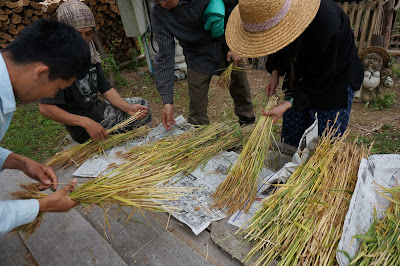
Since ancient time, transmission of crop seeds is closely linked with human movement, trade, pilgrimage, festival and parade, marriage, and so on.
wheat, mugi in Japanese, was transmitted from central asia through silk road, where noodles are largely enjoyed, and the varieties (churiki ko) suitable for making noodle was introduced in Japan via China.
milling technology has not been developed until edo-period in 16th century. Ishiusu, stone miller, made it possible to cook udon noodle, manju sweets, okonomi yaki, milled delicacy was developed.
 |
| traditional Japanese milling stone |
 |
| whole wheat bread |
wheat growing volunteers gathered from different regions can be transmitters for these wheat based on their preferences. Then after the selection by its climate and soil of the regions, the wheat will be rooted there, and I hope it will be inherited there to be its own heirloom variety.
 |
| mochi mugi, glutenous barley |
 |
| Indian chapati wheat |
 |
| Rokujo barley |
We are still looking forward to welcoming volunteer members to grow wheat, rice and beans.
We will make processed fermented food in winter season.
Sunday, 27 March 2016
Tea tour (1) Cultural Landscape and Tea Experience in Wazuka, Kyoto

Cultural Landscape of Japanese green tea
88th days from rishun 立春 (the beginning of spring) around 2nd of May is a symbolical in traditional japanese calender.Uji in Kyoto and Shizuoka are the most popular tea production area in Japan.
Uji tea plantation and its livelihood was designated as one of the important cultural landscape by Agency for Cultural Affairs, Japanese Government .
In fact, Wazuka town, located in south-western Kyoto, produces around 50% of uji tea produced in Kyoto and tea produced in Uji city is much less than in Wazuka.
Tea trees are everywhere around their housing in wazuka, as if their house is floating in the middle of the tea plantation, and wazuka is one of the 50 members for ”the most beautiful villages in Japan".
tea plantation scenery in Wazuka town.

tea plants in the left side is nursery
tea leaves can be picked 5 years after the transplantation, and can be harvested until 50 years old in general.older tea plant is also grown in the less commercially produced areas generally in the mountains. some plants are above 300 years old.
shuraku (community) and tea factories

This vallage called Yubune湯船, and there are many tea factories to process tea leaves.
chimnnies can be seen on the top of their roofs, and local residents are also unique to accommodate migrant labors working for their tea plantation. the labors are said to be from wakayama, where orange is main cash crop and temporary labors are working there in winter season and started to migrate tea plantation in spring time.
About Green Tea
There are two types of tea; fermented or unfermented (woolong tea is semi-fermented).
black tea is fermented, and green tea is unfermented tea.
there are two production methods to make green tea; one is covered by yoshizu (marsh-reed screen), called "ooishita" and the otehr is uncovered "roji", or open cultivation.
Characteristics of ooishita (plantation covered by marsh reed screen)
the merits of ooishita cultivation are as follows;
1. leaves are thick green colored
2. broader leaves
3. thinner leaves
4. smell and flavor become thicken
by covering tea leaves by the screen, the amount of sunlights is limited and therefore, photosynthesis capacity of the plants is enhanced; the leaves become thick colored and soft, and its smell and flavor will be strengthen.

Left: ooishita, covered by black screen for 3 days. Right: open cultivation
tea produced by ooishita cultivation is called "Gyokuro玉露" or "Tencha碾茶", which can be sold at a higher price compared to outdoor cultivated tea, called "Sencha"煎茶.
ooishita cultivation
● Ten cha:this tea leaf is used for processing match tea powder, and it is getting well-sold nowadays. after dried in brick oven, chop dried leaf and packed.

● Matcha : ground tencha leaf
● Gyokuro : after boiled, tea leaves are rolled, and become thinner like needle.
露天栽培
● Sencha : same process as gyokuro, but tea leaves for sencha are not covered and tea leaves for gyokuro are covered. |
| sun-block screen for ooishita cultivation |
Processing Green Tea
In 88 days after the spring, around 2nd May, is a season for tea picking.
It starts in the early morning generally under the gentle sunlight.
"Isshin Sanyo 一芯三葉" means one stem and three leaves.
this is the criteria to pick up tea leaves perfectly for tea pickers, usually ladies working as temporal labors in the tea farms.
Nowadays, most tea leaves are harvested by machinery, but hand picking is also undertaken especially for making high valued tea products and for contest tea called shuppin cha .


after steamed tea leaves, cooled down and rolled by hands on japanese traditional paper called "washi 和紙" coated by persimmon tannin, kakishibu 柿渋.

burned charcoal under the board, tea leaves are warmed.
and 4 hours later...
leaves become thinner and thinner like pine-needles...


This tool is called "bote", made from bamboo and japanese paper also coated with persimmon tannin.
A tea farmer told me that growing persimmon trees and tea plants in the same fields is a perfect combination; both grow very well with strong supplement with each other.

Tea Experience
●Tenku cafe (sky roof cafe)
Waduka cha cafe offer rental tea cafe at the great location with panoramic view of tea fields.http://wazukanko.com/experience/

●Tea tour Experience at Kyoto Obubu Tea Farm
Access
to visit wazuka, it takes around one hour from Kyoto station.
take trains bound for Nara from Kyoto station, and change train at JR kizu 木津 station to Kamo station 加茂.
then take bus from Kamo to Wazuka.
Sunday, 31 August 2014
Azumino Seed Center
Today, we visited a seed center in Azumino, Nagano Pref.

The seed center in Azumino was establish after the owner of "Shantikti", Mr. and Mrs. Usui visited a seed bank in Bangladesh. Mr. Usui guided us the facilities.
In the seed center, various bottles of seeds are lined up on the shelf. visitors can borrow seeds but should back the seeds doubled. the roof of the center is covered with various plants.
website (Japanese only)
http://www.ultraman.gr.jp/perma/seedhause.htm


collecting seeds of parsnip.

Web: Shalom Guest House (Trip Advisor in English)
552-1 Aisome Ikeda-machi, Kitaazumi-gun, Nagano prefecture 399-8602
In the center, the various ideas of permaculture are adopted: keyhole garden, companion plants, compost toilet, bio geo filter.
The concept of permaculture is established by Bill Mollison in Australia, but it's originated in Asia.
F.H King's "Farmers of Forty Centuries or Permanent Agriculture in China,. Korea and Japan"
"We can learn traditional knowledge on nature and farming methods deeply rooted in Japan through permaculture.", said Mr. Usui.
In the seed center, various bottles of seeds are lined up on the shelf. visitors can borrow seeds but should back the seeds doubled. the roof of the center is covered with various plants.
website (Japanese only)
http://www.ultraman.gr.jp/perma/seedhause.htm
collecting seeds of parsnip.
Access
Web: Shalom Guest House (Trip Advisor in English)
552-1 Aisome Ikeda-machi, Kitaazumi-gun, Nagano prefecture 399-8602
learning cross breeding at International Natural Farming Research Center
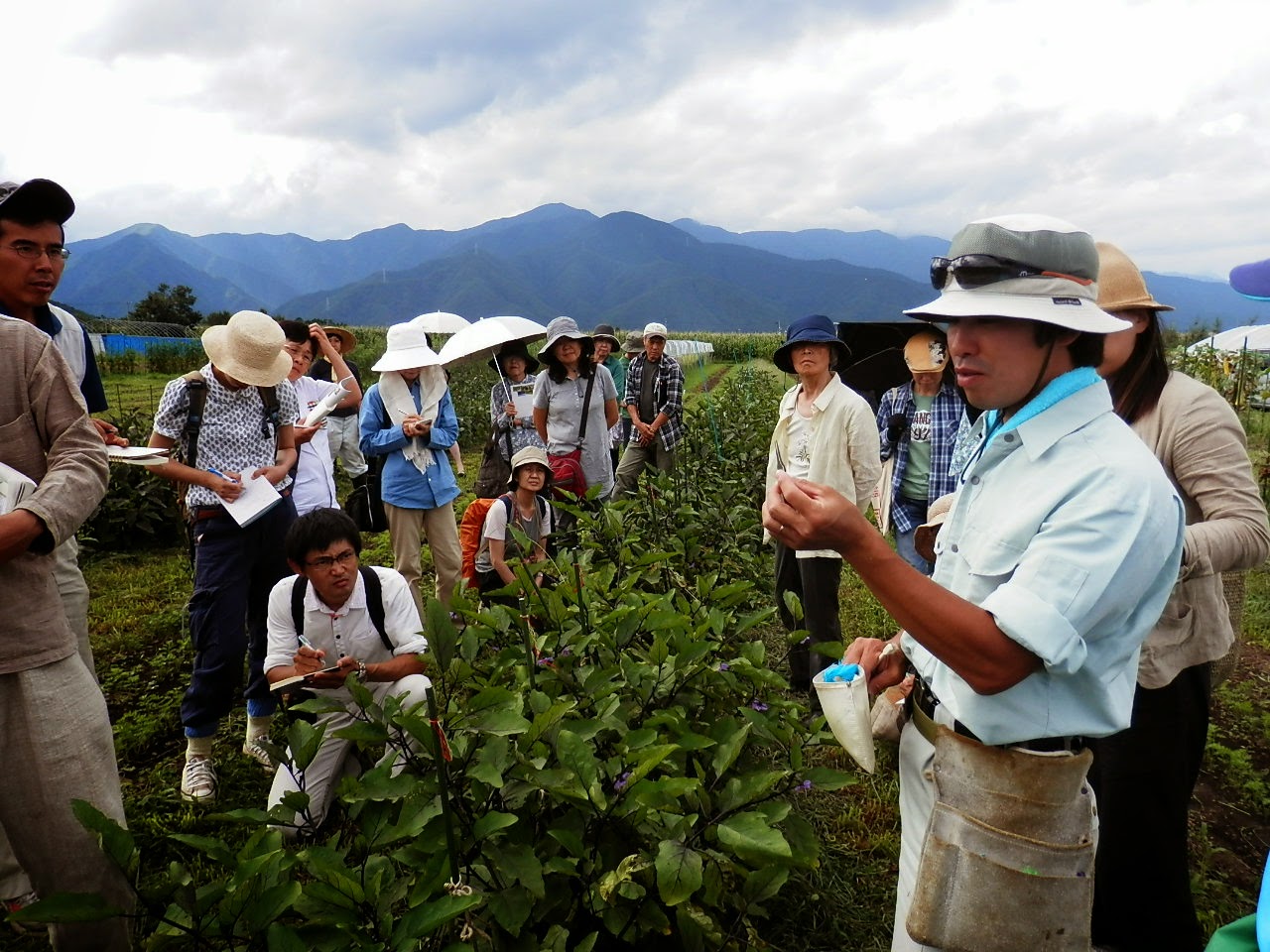
International Natural Farming Research Center was founded in 1983, advocated by Mr. Okada Mokichi, a founder of Natural Farming in Japan.
Now, natural farming was spread over the 40 countries. The research center promote farming methods without using fertilizers and pesticides, and also breeds organically produced seeds.
A researcher showed us how to breed egg plant, tomato and lettuce.
The code number is written on the cucumber for collecting seeds, so that they know the variety even if it's fallen.

we are learning breeding methods of egg plants.
Egg plant is a self-pollinating crop, and considered less likely to be intercrossed.
However, when you would like to save fixed pure seeds, you should emasculate stamen from the flower bud. then, the bud should be covered with a bag.
In 2-3 days later, the bud will be bloomed. then, extract pollen and interbreed.


This is hybrid tomatoes, mixed with red and yellow colored.

Lettuce is not crossed, and not necessary to be covered with bag.
when interbreed, all flowers should be washed out with water in order to make sure to be crossed.

Natural farming does not need fertilizers and vegetables are grown in the infertile soil. So, we have to consider how to enhance natural abilities of plants.
you can buy books on natural farming and seeds suited for natural farming from the web site of International Natural Farming Research Center.
Wednesday, 27 August 2014
Community seed bank in Fujino, Kanagawa pref.


Various millets and world vegetables collected by Tokyo Gakugei University are preserved in the fridge operated by "Fujino club"
The old building called "Mukei no Ie (intangible house)" is the center to share seeds with local people.
Members can keep and withdraw seeds from the seed bank.

in the collection, there is a millet variety which was once grown in Fujino city 40 years ago.
The member of Fujino club are trying to revive the millet, and growing together with local farmers.

I borrowed several seeds from the bank and deposited native seeds borrowed from Navdanya (foundation by Dr.Vandana Shiva) in exchange.
looking forward to exchange cultivation records of the seeds in future.
Iino seeds 飯野種苗ページ https://www.facebook.com/iinoshubyo
The member of Fujino club are trying to revive the millet, and growing together with local farmers.
I borrowed several seeds from the bank and deposited native seeds borrowed from Navdanya (foundation by Dr.Vandana Shiva) in exchange.
looking forward to exchange cultivation records of the seeds in future.
Iino seeds 飯野種苗ページ https://www.facebook.com/iinoshubyo
Subscribe to:
Posts
(
Atom
)


